
No pitch decks. No pressure. Just tell us a bit about your kitchen and we'll take it from there.
In partnership with
Featured in


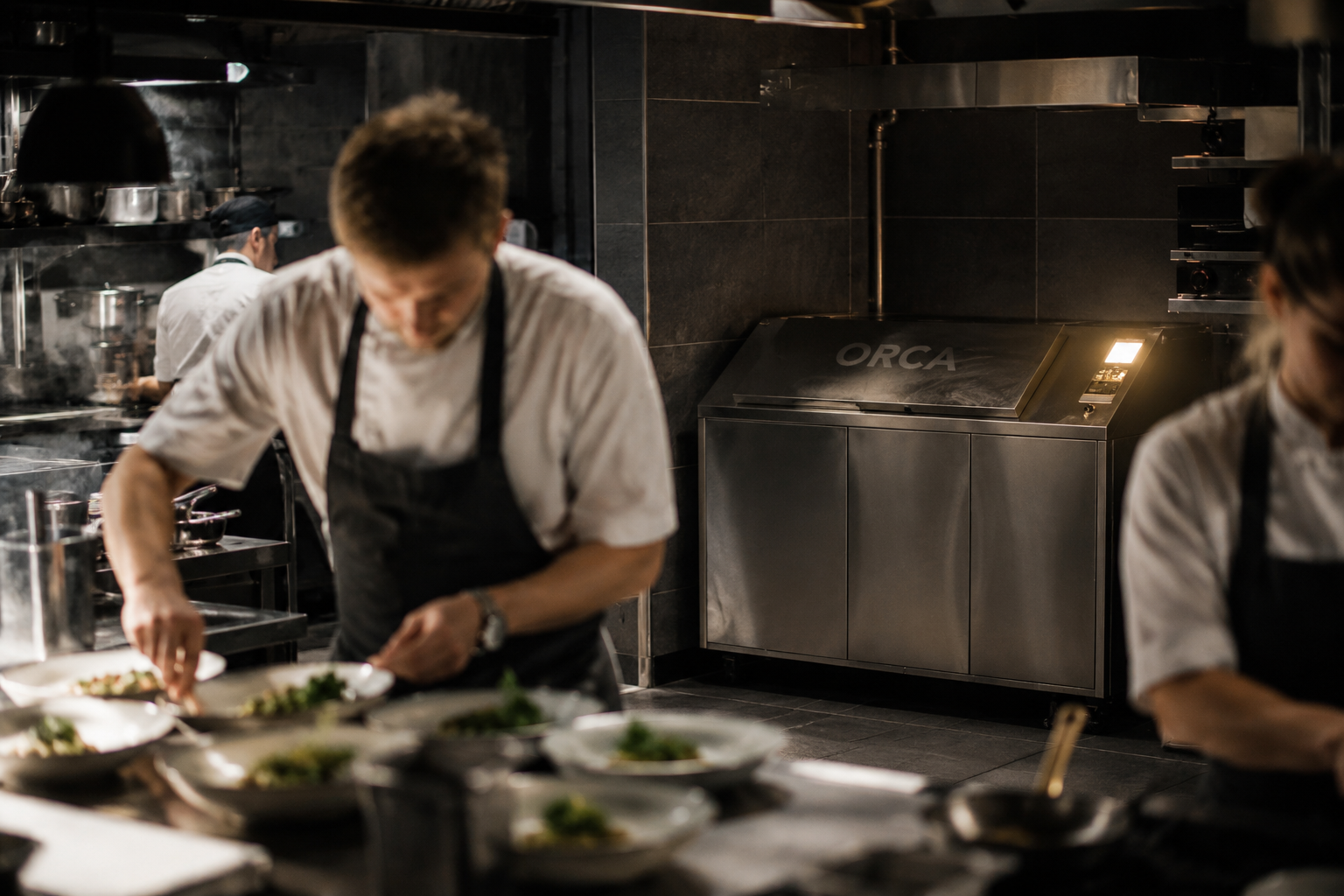
ORCA wins every time - Traditional food waste handling is outdated, bad for the environment, smelly, expensive, space-consuming and a waste of time.
ORCA is not.
Model Specifications
Four models, one system
Choose by throughput — from a single café counter to an industrial kitchen or cruise operation. Monthly figures assume 10 hours/day, 30 days.
OG25
Best forCafés, mid-size restaurants, canteens and boutique hotels.
OG50
Best forLarge hotels, cruise ships and commercial kitchens.
OG50LP
Best forSame power as the OG50 in a low-profile build — for kitchens with height or layout constraints.
OG100
Best forIndustrial kitchens, large cruise operators and hotel complexes.
Every model includes
Service & Consulting
From first contact to long-term partner
We don't sell a machine — we build a solution around your operation. Here's how we work with you, step by step.
A solution, not a product
When you reach out, we don't start with the machine — we start with you. The conversation begins with your situation, your kitchen and your goals, and the solution is shaped around them.
We get to know your operation
We look closely at how you work to estimate your waste volume and needs, the environmental impact, the economic value, and exactly how ORCA would fit into your day-to-day.
From decision to installation
If the solution makes sense, we work closely with you to bring it to life — guiding you through every step from decision to a fully installed, running system.
Understand it, communicate it
We help you get the most out of ORCA — understanding and communicating the environmental impact, the reporting, the staff routines and everything the solution makes possible.
We stay in your corner
After launch we remain available, supporting you on an ongoing basis for as long as you run ORCA.
ORCA+ Dashboard & Tracking
Data that works for you
Every ORCA unit measures what it processes — turning food waste into a competitive advantage, not just a compliance line.
Complete, accurate visibility
Every unit ships with built-in scales and meters that track all food waste processed — giving your operation an exact picture of what goes in.
More than numbers
The data reveals when and where the most waste is generated — the foundation for actively reducing waste over time, not just recording it.
The ORCA+ online portal
Track real-time diversion stats, set goals and generate reports — including CO₂ savings and environmental impact you can use in sustainability communication and marketing.
Flexible access
Monitor in real time over an Ethernet connection, or have data extracted and reviewed during service visits — whichever suits your setup.
How Does ORCA Work?
Aerobic digestion, explained simply
ORCA turns food waste into a benign liquid that leaves through the sanitary sewer — no grinding, no shredding, no chemicals.
What ORCA is
A food waste digester that turns food waste — both prep and post-consumer — into a benign liquid disposed of through the sanitary sewer system. There is no grinding or shredding: waste is broken down through constant movement, oxygen, water and a proprietary microorganism mixture.
How it digests
ORCA uses aerobic digestion — a bacterial process that requires oxygen to consume and break down organic substances, converting them into carbon dioxide, water and other molecular compounds in liquid form. It relies on microorganisms and ORCA's proprietary bio-medium, Biochips, which provide surface area for the microbiology and ensure airflow.
Where the food goes
Once broken down into liquid, it exits through a sanitary drain pipe, travels through a grease trap, and enters the local sewage system — where it is further processed into mainly reusable water and a small percentage of solids repurposed as soil additive or fuel for bio reactors.
Environmental impact
ORCA eliminates the need for traditional garbage-truck collection. According to the US EPA, one in six heavy trucks on the road is a garbage truck — each using roughly 8,300 gallons of diesel and releasing 74 metric tons of CO₂. ORCA is a no-truck solution. It also reduces methane from organic decomposition in landfills, and its effluent is handled by modern wastewater treatment plants — one of the most effective ways of processing nutrient-rich liquid.
No chemicals
ORCA uses no chemicals. The only active components are naturally occurring water, oxygen and microorganisms.
Sounds like science fiction — but it's pure science.
Why ORCA?
The case for ORCA
Two big wins — environmental and economic. Everything else is a bonus.
A climate-positive solution you can document
ORCA eliminates garbage-truck pickups — cutting CO₂ emissions, fuel consumption and methane from landfills. It lets your business actively reduce its environmental footprint and prove it. This isn't just good for the planet — it's increasingly expected by guests, partners and regulators.
Typically 30–70% lower waste costs
Traditional food waste handling is expensive. ORCA is cheap to run and removes the cost of frequent collection, so businesses typically cut waste-related costs by 30–70%. Over time the machine pays for itself through lower operating costs, fewer pickups and reduced waste volume.
No odors
Closed and odor-free in operation — no smell in the kitchen or storage.
Pest control
Less organic waste means fewer pests — a cleaner operation from the inside out.
Staff prefer it
Simple to use and clean to handle — it removes the worst part of waste management.
More hygienic
No containers of rotting waste sitting around; ORCA processes continuously.
Track & communicate
Document and market your impact with ORCA+ data — CO₂ saved and landfill avoided.